











Texas has been home to life long before the Europeans arrived, with the modern state being a crossroad between the Southwest and Southeast Native American cultures. These tribes include the Karankawa in the swamps, the Caddo in the east, and the Lipan Apache in the west. There are also plains and groups in the San Antonio area, such as the Comanche and Wichita, which migrated to Texas in the 16th and 1700s, and the Coahuiltecan language family.
The Coahuiltecan language family is a broad term for the group of hunter-gatherer tribes, along the Rio Grande and in South Texas, which share the Coahuiltecan language. Spanish exploration in Texas started in the early 1500s with Alonso Álvarez de Pineda, who mapped the Texas coast in 1519. After him, explorers such as Cabeza de Vaca, Francisco Vázquez de Coronado, Hernando de Soto, and Juan de Oñate chartered the coast.
Missions broken down
Missions: Nuestra Señora de la Purísima Concepción de Acuña, San Juan Capistrano, and San Francisco de la Espada were moved to San Antonio from East Texas in 1731, and Mission San José y San Miguel de Aguayo were moved to San Antonio in 1739.
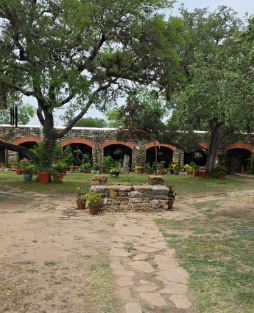
The purpose of the missions was to lay a Spanish claim to the area and convert the local natives to Catholicism and Spanish culture, turning them into Catholic subjects of the Spanish crown. This was done through an organized schedule of work, prayer, training, and other daily activities. The layout of the missions was like a walled fort, with a church inside. This protected the missions from attacks by hostile Indigenous groups such as the Apache or Comanche. The National Park Service states that native living spaces were simple and apartment-like with dirt floors, and oftentimes there was a bed and bucket for excrement. Although not common, some of the homes had a kitchen. Each room would house one family, while the priest’s rooms were similar in their simplicity but of greater quality. Missions would also host workshops, cemeteries, ranches, farms, and granaries used for grain storage.
The San Antonio Missions were made of local limestone bricks and covered with plaster. The walls were bland, mostly lacking architectural detail, with the churches being more ornate. According to the Texas State Historical Association, the missions were a blend of Renaissance, Baroque, and Spanish Colonial, with Moorish influences. The famous Rose Window in Mission, San José, is a good example of baroque detailing, and the geometric designs of the frescos in Mission Concepción stem from Moorish Islamic art. These frescos were made by applying a mineral pigment such as iron oxide or carbon to dry the plaster.
Life and Labor
Franciscan priests would oversee everything done in the mission. From leading prayers to managing the mission, as stated by the National Park Service, things taught by priests would include professions, reading, writing, as well as Spanish language and culture. Women would weave, make pottery, cook, care for animals, and do general chores. While Men would work farms, ranches, and learn blacksmithing, carpentry, and masonry. People would pray three times a day when they ate breakfast, lunch, and dinner. These meals would consist of jerky, tortillas, corn, and other locally grown crops. After dinner would generally be recreational time, for singing, dancing, socializing, and playing. Natives who lived at the missions would receive punishment for breaking rules such as speaking their native language, practicing their native religion, or practicing their culture. These punishments would include beatings, imprisonment, and forced labor. The only Indigenous group to accept mission life was the Coahuiltecans, due to their previous hunter-gatherer lifestyle becoming increasingly more difficult than it already was. The missions provided a steady and reliable source of food, as well as protection from raids by Spaniards, Apaches, and other aggressive tribes. Other tribes did not have the need for mission life as much, causing missions in other areas of Texas to fail. This is the reason that the Missions San Juan, Espada, and Concepción were moved from East Texas.
To irrigate farms and provide water, the missions used acequias. A system of canals that worked by having gravity pull water through. According to the National Park Service, dams were used to raise water from the San Antonio River to the acequias, where the water would then travel to the missions. Aqueducts would be used to account for ditches and gaps in the terrain, keeping water flowing. Mission Espada has the oldest remaining Spanish aqueduct in the U.S. and is one of two San Antonio Missions with its dam intact. In San José, the acequia would power the San José Gristmill, the first water-powered mill in Texas. The gristmill sat just outside the wall, near the church. Water would flow to the gristmill, turning a water wheel, which was connected to a stone that would grind wheat into flour. This provided an easy and reliable source of food.
Remembering the Alamo https://www.historyextra.com/period/victorian/remember-alamo-what-happened-siege/
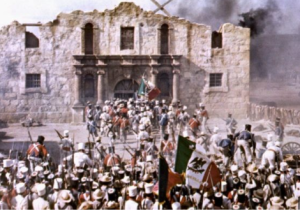
According to World Heritage San Antonio, the first mission in what is now the San Antonio area was Mission Valero (The Alamo), established in 1718. It was not moved to its current spot until 1724. The missions were active for the majority of the 1700s, until the early 1790s, when they were partially secularized, as stated by the Texas State Historical Association. By 1824, the missions had been fully secularized, and the church lost control over them. This happened because many felt the missions were becoming less useful. The Coahuiltecans were not a very large group, and the missions failed to convert the number of Indigenous peoples as hoped. Most of the relatively few Indigenous people who did convert would usually die from European diseases like measles, bubonic plague, and smallpox. The National Park Service asserts that the Spanish crown, which was already losing money from inflation, wars, and a lack of industry, didn’t view the costly missions as profitable or impactful enough. The mission’s other purpose of establishing Spanish control of the region had failed. Even with the missions, Spain’s claim on Texas was weak since most territory was controlled by the Comanche, Lipan Apache, Wichita, Tonkawa, and other tribes. The United States was also encroaching on Texas, the Louisiana Purchase, which the U.S. brought from France in 1803.
This problem continued when Mexico gained independence and control of Texas in 1824. According to the Official Alamo website, to protect their claims, Mexico passed the law of April 6, 1830, which sent Mexican soldiers to Texas, prohibited American Immigration into Texas, and outlawed the further introduction of slaves. Despite this, many Anglo-Americans illegally immigrated to the Mexican state of Texas. The Mexican presence in Texas angered many American-Texans, who took up arms against the Mexican government in the Texas Revolution. The most famous battle of the Texas Revolution was the Alamo, which took place at Mission Valero from February 23rd to March 6th, 1836. This would cause the mission to become more than just another mission; it was the Alamo. The mission would become an important landmark for the city of San Antonio, and a source for city and state pride. This would bring attention and awareness to the San Antonio Missions as a whole and increase the popularity of preservation.
After secularization, the missions were abandoned, and they would fall into ruin and be mostly unused. From 1846 to the late 1870s, the Alamo was used as a military depot for both the Union and Confederacy. In the 1850s, Mission Concepción was a cattle ranch, and in the 1880s, the long barracks at the Alamo were a general store. The Alamo states that, in the late 1880s, preservation of the Alamo began. One group that greatly influenced the preservation of the missions was the Daughters of the Republic of Texas. Clara Driscoll, founder of the Daughters of the Republic of Texas, led the preservation effort for the Alamo in the early 1900s. The group was made custodians at the Alamo in 1905. Throughout the late 1800s, small-scale reconstruction of Missions San José, San Juan, Concepción, and Espada occurred.
From the late 1800s to the early 1900s, the church would eventually regain control of the missions, with control over San José being gained in 1931. Church services would also start again. Around the same time, in 1924, the San Antonio Conservation Society was founded. It purchased land around the missions and helped fund restoration projects. According to the Texas State Historical Association, in the 1930s, large-scale reconstruction of most missions began. Mission Espada would finish reconstruction in the 1950s, and San Juan would have major reconstruction in the 1960s. There are still smaller-scale reconstruction projects that have occurred since. In 1982, Missions San José, San Juan, Espada, and Concepción were all designated as a national park. Due to this, the National Park Service entered into joint ownership of the missions with the church. The National Park Service manages the secular buildings, while the church manages the church building and services.
Epilogue
In 2015, the San Antonio Missions were made a U.N.E.S.C.O. (United Nations Educational, Scientific and Cultural Organization) world heritage site, the first world heritage site in Texas. A U.N.E.S.C.O world heritage site is a designation given to certain natural or man made places which have universal value to humanity. This designation comes with international legal protection and increased tourism. Today, preservation of the missions still continue, with things such as stabilization of the Mission Concepción tower floor, repair of the Mission San Juan bells, and restoration of the Mission San José Indian Quarters. The National Park Service also partners with the San Antonio River Authority for river cleaning and reintroduction of native species. Research and education such as archeology at the Alamo, and educational tours at Mission San Juan are also conducted by the National Park Service.
The missions have had a great influence on the city of San Antonio’s development. They provided the first settlement at the current site of the city, acting as the backbone for original growth. The acequia system allowed for both population, and economic growth. The city of San Antonio, despite being one of the fastest growing and the 7th largest city in the U.S., has a relatively small skyline compared to other major cities. This is because the missions, being spread out, forced construction to be built out to reach all the missions, instead of built up with big skyscrapers. In the present day, the missions, most importantly the Alamo, generate income for the city through tourism. As stated by the National Park Service, the intermingling of Native American and Spanish culture that occurred at the missions during Texas’s time as a Spanish colony formed the basis for South Texas culture. The missions are why catholicism is dominant here, and why there is a large hispanic population. The history of the San Antonio Missions greatly influences the modern city.
Sources:
National Park Service
Texas State Historical Association
Official Alamo Website
World Heritage San Antonio